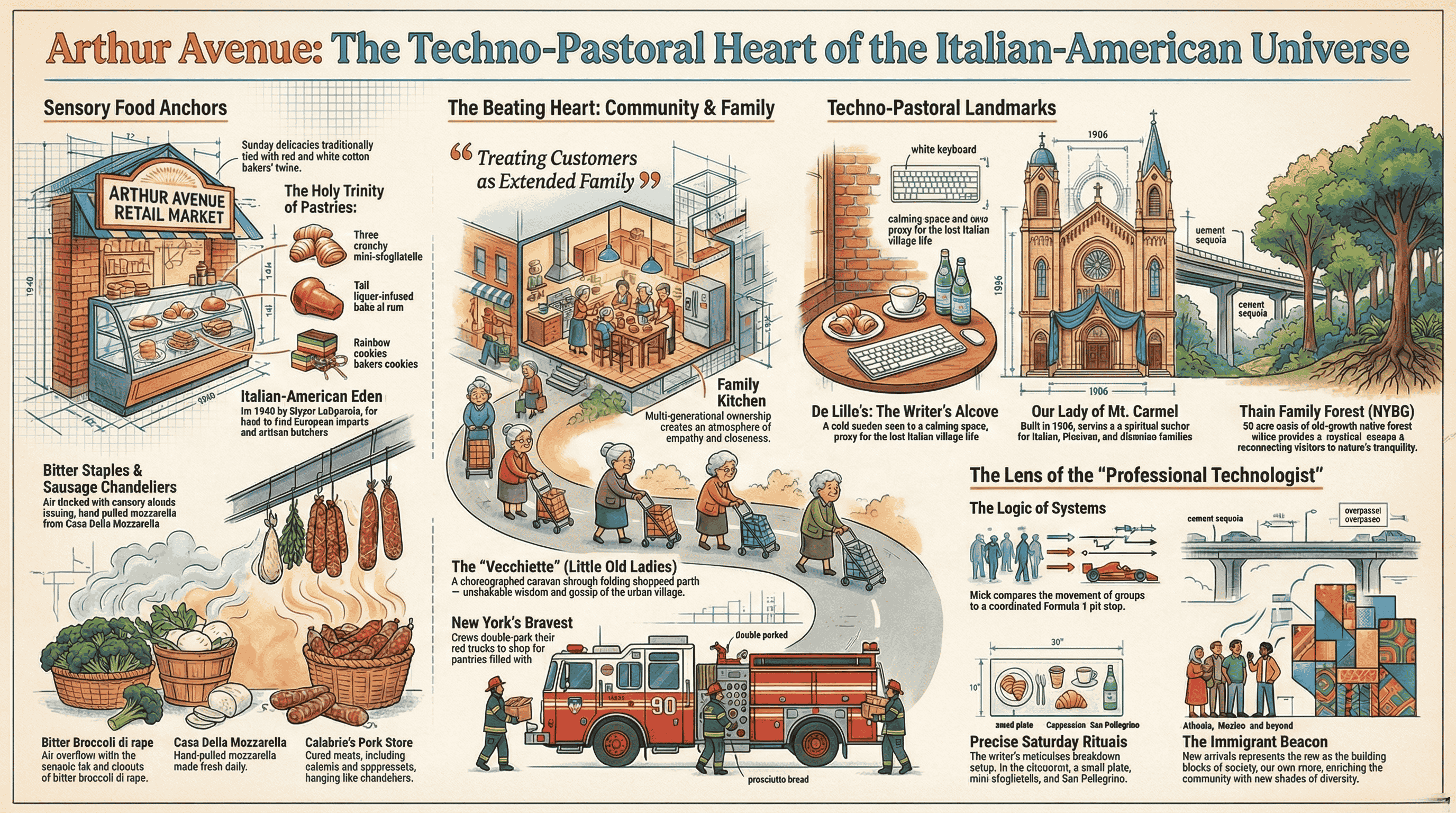
Sitting at my writing alcove in De Lillo's pastry shop, arranging my small plate of three mini-sfogliatelle on this late summer, rainy afternoon, I found myself pondering the intersection of our digital future and our immigrant past. It all started with a simple logistical need: trying to send a friend the "Last Mile" directions to the municipal parking lot on Hoffman Street so they could join me here in the Belmont section of the Bronx.
But as a professional technologist, my mind naturally gravitated toward the logic of systems. Why just send a sterile, transactional map? Instead, I engaged in an ideation exercise that blossomed into a beautifully illustrated, ten-slide companion pamphlet for touring Arthur Avenue. We did not just outline street corners; we packaged an entire cultural ecosystem.
"Technology, when guided by radical empathy, does not have to be a cold instrument. It can be a canvas for our shared history."
This is the profound beauty of our current technological era. I have often questioned whether the recent AI inflection point is a looming Singularity or just a bad psychedelic trip. Yet, what I experienced today was a revelation in content co-creation. By bringing together human-created content — the deeply emotional memories of my olive-skinned artisan father, my mamma who made the most comforting polpette di riso, and my sisters playing in the back of our old Pontiac — with AI-generated storylines and graphics, we are able to "industrialize" the making of digital art. The AI acts as a creative partner, enhancing our humanity rather than erasing it. It allowed me to digitally render the vibrant "sausage chandeliers" of the local pork stores and the rich, multi-generational warmth of this neighborhood without losing the soul of the experience.
We certainly have strayed a bit today. But the point is this: technology, when guided by radical empathy, does not have to be a cold instrument. It can be a canvas for our shared history. Arthur Avenue remains the center of the Italian-American universe, a proxy for the village life my family left behind. The immigrants who built these streets are not "the other"; they are the building blocks of our society and the constituency that will continue to keep America great.
My prayer of hope is that as we step into this new world of AI-assisted creation, we use these tools to spread unity and greater respect, capturing our beautiful human stories before they fade into the ether.